

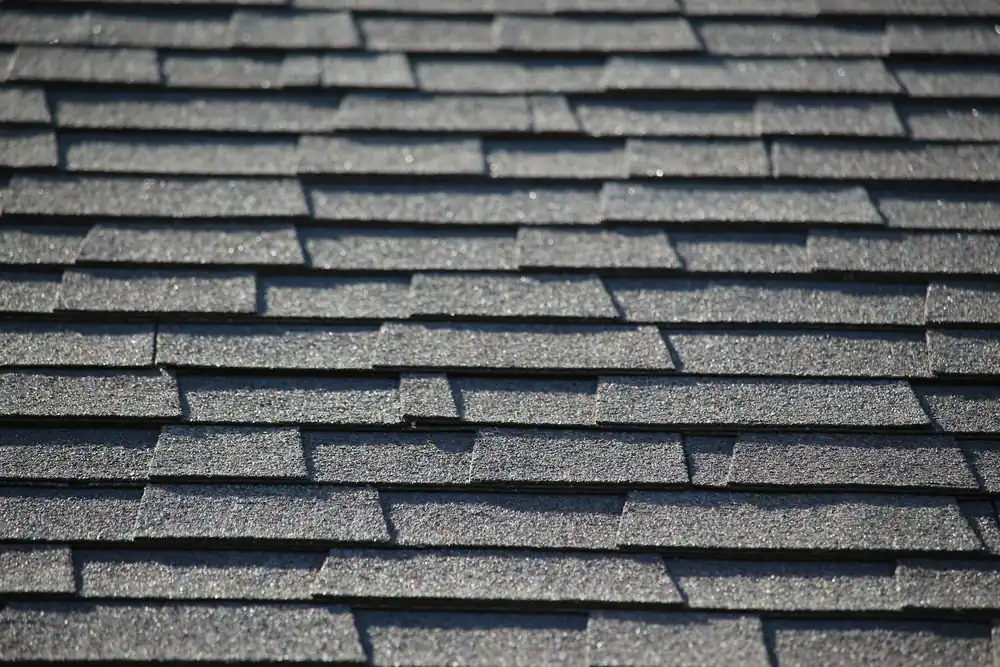
Every asphalt shingle on your house is covered in tiny mineral granules. They are what give the roof its color, and they are doing a job that has nothing to do with looks. That granule layer is the shingle’s sunscreen.
So when a homeowner in Cleveland cleans out the gutters in October and finds what looks like coarse black sand in the bottom, the question is reasonable: how worried should I be?
The honest answer is that it depends on how much, and on how old the roof is.
What granules actually do
Underneath the granules is asphalt. Asphalt is what makes the shingle waterproof and flexible, and ultraviolet light is what destroys it. The granule layer sits on top and takes the sun so the asphalt does not have to.
That is the whole arrangement. Lose the granules and you expose the asphalt. Expose the asphalt and it dries out, stiffens, and eventually cracks.
This is why granule loss matters more than it looks like it should. A few spoonfuls of grit in a downspout does not seem serious. What it represents is a small reduction in the roof’s ability to protect itself from the next fifteen summers.
When it is normal
A brand new roof sheds granules. Manufacturing leaves loose material sitting on the surface, and the first few rains wash it into the gutters. Installers expect it. If your roof went on last spring and you found granules this summer, that is the roof settling, not failing.
Weather events also knock granules loose. A hard hail line moves through Bradley County, and every roof under it gives up some surface. One heavy storm followed by a modest amount of grit is a roof doing its job.
The pattern to watch for is different. It is steady, it repeats, and it happens on a roof that has already been up there a while.
When it is telling you something
Here is a simple way to sort the two apart.
| What you are seeing | What it usually means |
|---|---|
| Light scatter on a roof under two years old | Leftover manufacturing granules washing off |
| Grit after a single hail or wind event | Normal weather response, worth a look after big storms |
| Steady accumulation on a roof past ten years | The surface is thinning; the roof is aging |
| Bare dark patches visible from the ground | Granule loss has progressed to exposed asphalt |
| Granules plus curling, cracking or brittleness | Several aging signs at once, time for an evaluation |
The bottom two rows are the ones that change what you should do next.
What we look for when granule loss shows up
Granule loss almost never travels alone. By the time a roof is shedding steadily, it is usually showing other things too, and those other things determine what the roof needs.
We look at whether the shingles still flex or have gone stiff. We look for cracking through the mat rather than surface checking. We look at the south and west slopes first, because in this part of Tennessee those take the worst of the afternoon sun and age ahead of the rest of the roof. We look at whether bare asphalt is showing anywhere.
A roof that is shedding granules but is otherwise sound is in a different situation from a roof that is shedding granules because it is at the end of its life. Both look similar from the driveway. They are not the same roof.
What can be done about it
Granules do not come back. Nothing puts them on again short of replacing the shingle.
What asphalt shingle protection aims at is the shingle you still have. GoNano Structural Roof Rejuvenation is designed to work inside the asphalt rather than coat over it, and GoNano reports that improved granule retention is one of the results for qualifying roofs. The idea is to help the shingle hold the granules that are still attached, and to restore some of the flexibility that keeps the mat from cracking as it dries.
That only works on a roof with life left in it. A shingle that has already lost most of its surface, or that has gone brittle enough to crumble, is past the point where treatment is the right answer. When we see that, we say so, and the next call belongs to a roofing contractor rather than to us.
What to do this weekend
Look in your gutters. Look at the ground under the downspouts, where granules collect in a small dark pile that is easy to mistake for dirt.
Then look at the roof itself from the yard, ideally in morning light when the angle is low. Bare patches read as darker, flatter areas against the rest of the slope. Curling shows up along the shingle edges.
If you find granules and the roof is under ten years old with no other symptoms, note it and check again after winter. If you find granules on an older roof, or you find them alongside anything else on that list, that is the point where a roof evaluation is worth the time.
Not because the roof is finished. Because the window where something can still be done about it is open, and it does not stay open forever.